Wednesday, February 10, 2016

The Understudy


We’ve been talking a lot about finishing projects. While not completely done with some ideas about tops and piecing, I did want to talk about another part of finishing your quilt or your quilted project – the batting.
 

Batting – or wadding as it’s called in England and Australia – is the “understudy” in the quilt play.  It’s not seen, but the correct choice is oh, so very necessary in order for a command performance.

When I first started quilting, my choice of batting was pretty easy -- whatever was the least expensive or on sale. And at that time thick, fluffy polyester batts ruled.  There wasn’t a cotton batt to be found.

Time has passed and there are now more brands of batting and they are comprised of everything from cotton to recycled goods.  Before we move into what kind of batt is needed for a certain look, there are some universal ideas that need to be kept in mind no matter if you're purchasing Hobbs or Mountain Mist.
 

Size – Keep in mind that your batting (and your backing) need to be at least three to four inches larger than the quilt top.  These extra inches are to allow for some “shrinkage” during the quilting process. 

Packaging – There are lots of battings available that are pre-cut and labeled according to size.  If one of these is used, be sure to let it “relax” before quilting it on your domestic machine or by hand.  When a prepacked batt is taken out, there are lots of creased folds in it.  Lay it out somewhere overnight so that most of this can fade away.   All the folds won’t disappear, but they will relax a bit, so that when the quilt is pinned or sprayed to keep the top, batting, and back together, wrinkling won’t be as big of an issue. 

If the quilt is going to the long arm artist, check with her or him about this step.  Quite often this step does not apply if the top will be quilted on a long arm.  As a matter of fact, some long arm quilters prefer to use their own batting.  Quite often they purchase batting in rolls and keep their favorites in stock. 
 

Use – Most quilt tops use some sort of “standard” batting.  Fiber content and loft (thickness) can vary, but they usually don’t require some special type of batting.

However, if you’re making some of those bags you bake potatoes in the microwave or the microwave bowl holders, then you need this…
 

And not regular batting. 

Likewise if you’re constructing quilted bags.  With those need a lower loft, stiffer batting that is fusible. 

So now let’s consider the fiber content of batting.  I know this sounds like really boring minutia, but months are spent making a quilt top.  Hopefully during this process you have a vision of how you want your completed quilt top to look.  Choosing the correct batting will allow this vision to become reality and content is key.

Most batting is either cotton or polyester or a combination of the two.  Wool, silk, and bamboo are also used for batting and there is a batting that is made out of recycled material.  There are also batting that is completely organic.
 

Each type of batting gives a different look.  If a flatter, more traditional “puckered” look is desired, then a cotton batting is the best choice.  These are generally thin and can stand up to the heavy-duty quilting that gives that antique “puckered” look on quilts.  If you want a traditional look, but want the quilt to be a bit thicker, use two layers of cotton batting.

If the quilt is probably going to see the inside of a washing machine quite a bit, a polyester batting may work best.  If you started quilting in the  1970’s or 1980’s I know what you’re envisioning – those thick, fluffy polyester battings that were almost impossible to quilt well, whether you were machine or hand quilting.  Polyester batts have come a long, long way and are nothing like that now (although the thick batts are still available if desired).  A quilt, such one for a child, that is going to be laundered a lot, would be a great candidate for a polyester batt.  Those battings hold up well to heavy-duty play and heavy-duty washing.

Is the quilt a “show quilt?”  If the quilt has a show in its future, careful consideration should go into the batting.  If a more “traditional” look is required (that antique puckered look mentioned earlier), a cotton batting would be a great choice.  A cotton batting will show off the piecing more than the actual quilting.

If the quilt is heavily appliqued and the quilting outlines the applique pieces, a good choice is two battings – regular cotton batting against the backing and wool batting next to the top.  The wool batting can stand up to that type of heavy-duty quilting and the combination of the two batts make the applique “pop” off the quilt top.
 

What’s the temperature? – If the quilt will live where it’s really cold, consider a wool batting.  It’s light but the warmest there is.  Likewise if you’re living where it’s kind of balmy in the winter, a thin batt would be best.

My favorite kind of batting for a quilt that’s going to be on my bed or given away is the 80/20 blend.  It’s 80% cotton and 20% polyester.  It looks really good and holds up well. And it's easy to quilt.

All of the types of batting discussed so far work pretty well if you’re quilting on a domestic or mid-arm except the thick polyester battings.  Those are bulky and can be difficult to fit in the neck of the machine.  However, they make wonderful tied quilts. 

What if you’re planning on hand quilting?  I’d pick a polyester batt.  They’re just easier to needle.  If you have to have a natural fiber, pick the lowest loft available.  Cotton batting is needle punched to keep the fibers together and this makes hand quilting a challenge.  The lower the loft of a cotton batt, the less needle punching is on the surface.

Silk batting is the best choice for hand quilting, but it is expensive and requires some special consideration.  Silk doesn’t cling well, so additional pinning is usually needed. 

Quilt color – Usually the cream/beige/ecru color batting works well with just about anything.  But if the quilt’s background fabric is white, white batting should be used.  If the background fabric is dark, black batting is the best choice.
 

Information on the back of the package

Like a lot of things, batting has its own special vocabulary.  Here’s a quick rundown of some terms you need to be familiar with:

Quilting Distance --   The maximum distance between rows of quilting needed to keep the batt in place. 

Scrim – Term used to describe the light layer or grid of woven fibers added to some cotton battings.  It stabilizes and holds the fibers together.  If you’re planning on keeping your quilting lines close together, you can use cotton batting without scrim. 

Bonded – These are battings made with glue or bonding adhesive.  When laundered, some of this bonding may wash away, leaving your batting loose.  If using a bonded batting, plan on really small quilting distances.

Bearding – These are wispy fibers from a batt that creep out through the top of a quilt top.  This can completely ruin the look of a quilt.  Bearding usually occurs when a cotton batting doesn’t have scrim or when using  polyester batting (because the fibers are so thin they can migrate through the top).  The best batting companies manufacture their product so that this doesn’t happen with either cotton or polyester batts.   Buy accordingly.  The least expensive batting is not always the best choice.

Fusible – This means that the batting can be ironed into place and will not require either a spray adhesive or pins to keep it where it needs to be.  Fusible batting works really well for small projects, but it’s harder to use on large quilt tops. 

Lastly, don’t throw your batting scraps away.  Larger pieces can be joined with either the iron-on quilting adhesive tape or butted together and zig-zagged.  Smaller pieces work wonderful on a Swiffer sweeper! 
 

So, as you’re finishing projects, don’t scrimp on the batting.  It’s the unseen part of your quilt, but it’s just as important as the top.


Love and Stitches…


Sherri

Saturday, February 6, 2016

Whispers from the Past


I quilt for a lot of reasons.

Sanity is the primary one.  I work with numbers and men. 

All. Day. Long.

Demolition and environmental work isn’t exactly heavy with female workers.  I deal with primarily male workers and executives and then Quickbooks every day. 

And I’m married to the boss.

So yes, sanity is my primary reason I keep quilting.  When I come home and am able to hole up in my quilting room even for 45 minutes, I find I’m a lot calmer person and have much more clarity. 

Creativity is the second reason I quilt.  When I was younger, I was always drawing and creating with paint and paper.  Eventually this translated over to fabric and a sewing machine.  Quilting gives me a creative voice in my life.  Choosing fabrics and patterns uses parts of my brain that numbers don’t use.  And I love changing patterns up to suit what I want to say or even designing my own.

But there’s another, even more subtle, reason I quilt. 

According to what I can find researching my mother’s side of the family, I am at least a fifth generation quilter.  I’m an Ancestry.com junkie and I have traced my mother’s side of the family back for many years.  When I come across some of these women’s obituaries, I find the quilting bee they belonged to listed right alongside the Sunday School class they attended.  Putting needle to fabric lets me hear the whispers of voices from the past: Cora Perry Forbes.  Annie Elizabeth Wolfe Perry. Susie A. Holaway.  Isabella Nelson Perry.  Celia Hatfield Perry (yes…those Hatfields who are forever linked in a feud with the McCoys). Susie Holaway even lived in the same town I now reside in.  I pass the street her house was on almost every day driving home from work.

Is quilting in my DNA?  Maybe.  Is it something I just naturally had an inclination to do because I saw a lot of my female relatives do it?

The answer to that would be no.  I don’t ever remember seeing my grandmother quilt.  I have watched my mother quilt, but that was after I had started quilting myself.  I do have a quilt in my possession that my great-grandmother made.  It was that quilt that started the process in me. 

The burden…the need… to continue an art that has not only supplied my ancestors with warmth, but the women with an ability to express themselves during a time when that was somewhat frowned upon, is another real reason I keep needle to fabric in my spare time.  It’s my fervent hope, that as my daughter’s and my daughter’s-in-law lives progress,  that they will also turn to quilting.  And that their daughters do, too.

An art such as quilting is always and only just one generation away from extinction.

If I could go back in time and talk to my grandmothers, I would ask they value their work.  Preserve those quilts.  Put a label on them with dates and tell who they were made for and why.  Hand them down to family members that would love and respect the quilts and take care of them.  So much love, sweat, and even tears go into a quilt.  It pains me to see them carelessly discarded and overlooked.

I think that as we are piecing and quilting, we need to remember those that have done it before us.  I’m sure if Susie Holaway could visit me today, she would be amazed at rotary cutters and mats and all these computerized sewing machines.  She used scissors and templates and a treadle machine.  But I’m also pretty sure that she’d encourage me to keep the art moving ahead, even if though I’m using drastically different methods and have the money to purchase fabric specifically for a quilt and no other reason.

This week, I encourage you to keep the past a part of your present.

Love and Stitches,

Sherri


Thursday, January 28, 2016

Proof and Chocolate Pudding


There is an old saying; “The proof is in the pudding.”

Frankly, I’ve never been sure what that means.  And pudding has never stayed around my house long enough for me to figure it out – especially if it’s chocolate pudding.  What kind of proof does pudding need?

For the last couple of weeks my blog has been all about finishing projects, working your schedule so you can finish projects, and moving forward.  It’s been very verbal, so this week it has more pictures – the proof that I do take finishing seriously and do actually complete my projects.


The picture below is my Amish with a Twist quilt.  The pattern in by Nancy Rink.  This sucker is huge – somewhere between a queen and king.  Originally I had thought I would quilt it on my Juki 2010Q, but I think this may be long-arm-artist-worthy.
 
This is a close up of the applique.  I machine appliqued the flowers, stems, and leaves.


The Quilt History Club I belong to did a Mystery Quilt this year.  I completed my last block on New Year’s Eve and put it together during North Carolina’s Snow Meggadan last weekend.  This is a wall-hanging-sized quilt.  I will quilt this one on my Juki 2010Q.


And finally I did start a new project.  I’ve always wanted to make the Farmer’s Wife Quilt (1920).  There was a class that started this quilt as a BOM at Dragonfly, so I  signed up.  These are the blocks I’ve completed so far.


I will have more next week.  If you’re in North Carolina this week, the Statesville Quilt Show is this weekend.  Come see me at Dragonfly’s booth!


Love and Stitches…

Sherri

Thursday, January 21, 2016

There's a Time for Every Purpose Under Heaven...


Continuing where we left off last week…that finishing thing…

We are all busy.  My mom, who has been “retired” for a number of years, tells me she’s busier now than she ever was when she was working. That information (and the fact that Mom straight-up tells me like it is) does not bode well for what I want to do after my husband and I sell our business.

I currently work full-time in that business, do my own housework (someone tell my husband there is such a thing as maid service, please), and work part-time in my local quilt store to support my fabric habit.  I’m an active member of my local guild and am a board member of The Applique Society. 

Busy….that’s what I am.  And in many ways, I like “busy-ness.” It keeps me focused and off the couch, watching TV for hours. However, all of these activities require me to be fairly organized as far as my quilting is concerned. 

Teaching high school really, really taught me how to plan.  I found that a good planner went a long way in assisting me.  And I have tried almost every planner on the market – paper, computer—you name it, I’ve given it a whirl.  I’m old enough to appreciate a tangible, carry with you, paper calendar/planner more than something on my phone (gosh darn why do they make those screens so small?) or on my computer (who carries their lap top with them any longer?) or iPad (again with the small screen thing coupled with the small key pad).

So with the fact that I have years more than you’ll ever get me to admit under my belt dealing with planners, let me tell you how I use them in my quilting.  Everything in life is pretty much scheduled, right?  Work, school, dentist appointments…nearly everything has a time slot.  Quilting should have that, too.  Everyone has a thousand things to do and just so many hours to do it in.  If quilting isn’t given a time slot, projects are never going to be finished.

“But it’s just a hobby…and there are other things I have to do…”  Yeah, I can hear that all the way over here.  And while true, quilting isn’t as necessary as your job, spending time with your family, or getting that root canal you need, it is still necessary. Quilters quilt for a variety of reasons.  Quilting uses the parts of the brain that assist in problems solving and it helps prevent Alzheimer’s.  It keeps math skills sharp.  But most quilters quilt because it gives them a chance to be creative and it gives an escape from reality.  The time spent with beautiful fabric, wonderful patterns, and other quilters allows us to forget about bills and illnesses and that co-worker that absolutely drives us nuts. 

So yes, quilting is necessary.  And so is finishing.  If quilting is given a time in your day or week on a regular basis, projects will be completed – and remember finished is better than perfect.

I have found that this little planner currently fits all my needs at this time.  And I really, really wish it was around when I taught school. 
 
It’s by Plum Paper and it is fabulous. Scheduling is a snap and the calendars are big enough to write everything down. 
 
There is also a project section that I use each week to set goals about what I want to accomplish.  Each week I can check them off as I go and plan ahead for the next week.  As I’m planning ahead, I can consult my patterns to see if I’m at a point where I’m going to have some issues.  If one quilt project is going to need more time because it’s at a time-consuming point or the next part is just difficult for me, I can allot more time for that project. 

That way, every project keeps moving forward. 

And that’s important.

Love and Stitches…

Sherri

Please note that I am not on staff with Plum Paper and receive no payment or products from that company.  I use their planners and absolutely love them and the way they can be personalized.  The calendars can be ordered at any point on the  year and can run 12 or 18 or 24 months.  If interested, visit their Facebook page.


Thursday, January 14, 2016

The Whole Enchalada


I love new projects…

There’s something about new fabric and new patterns that just put the creative juices into overdrive and sends inspiration and ambition down on angel wings. I can’t wait to get them home and into my quilt area and just…start.

Starting is the easy part.  Finishing is, well…harder.  I have great plans, great ambition, and great intentions.

Only sometimes to have all three melt away when I find newer fabrics and newer patterns.

So this year, in some of my blogs, I want to discuss finishing – the process, tricks, tips, and how I make it through to the end.  I have always had to be somewhat organized since quilting isn’t my full-time job yet.  I’ve always worked one or more full time jobs in addition to teaching, designing, and making my quilts.  I’d like to share my process with you.

It’s hard to pinpoint what inspires us to undertake a new project.  For me, sometimes it’s the fabric.  If there’s a line of fabric that just takes my breath away, I’m known for buying two yards of each bolt and five of the one that I want as the focus fabric.  That fabric may sit on my shelves for a while – until I find a pattern that works. 

Here’s where my new iPhone comes in handy.  I’ll take a picture of the fabric with it.  That way there are no fabric swatches to lose.  I can pull my phone out, go to my pictures, and have it with me at any quilt show or fabric shop.   I can compare the material that is there to those in the picture (in case I’m short a few yards) as well as see if the pattern I’m considering will work with the fabric.
 

Sometimes it’s the pattern that drives me to start a new quilt.  If this is the case, after I purchase the pattern, I use my iPhone to take a picture of the front of the pattern and the sheet that has the fabric requirements on it. 
Lovely in Lavender by Debbie Beaves


My iPhone also has the option of turning the picture from color into a black and white photo.  I frequently use this option to study the color structure of the pattern – this allows me to see the darks, lights, and medium values used without being influenced by the colors the designer has chosen. 
 

That’s how it starts.  I think that’s how it starts with most of us.  Fabric or pattern…sometimes both…often dictates what we’re going to do next.  And I think this where a lot of quilters make errors.  We tend to think of this as the first step, instead of thinking through the quilt process in its entirety.  In fact, unless you are beginning quilter, I don’t think you should think in steps at all.  Beginning quilters have to, because they are learning and every concept is new.

However, if you’ve got three or more quilts under your belt, the time of thinking in steps as you pick your project is over.  I believe the reason a lot of quilters “hit the wall” in their quilts is that they can’t see beyond the excitement of new project.  Regardless of whether it’s the pattern or the fabric that has driven a quilter to start something, you have to see beyond this. 

For instance, take this little quilt top I finished this weekend.
 

This is Spring Bertie by Bonnie Sullivan.  I love Bonnie Sullivan’s patterns and the wooly flannels that have been designed to go along with them.   I decided I wanted to make this pattern, but there were a couple of issues I had to determine how to deal with before I committed to the project.

The first issue was that a lot of applique is involved.  I love applique, but I’ve already got two handwork projects going, and I really did not need another one.   I had to make a decision to be satisfied to machine applique it.  The background was not a firm cotton, but a soft flannel, so I had to make sure there was a stabilizer I could use that would allow the flannel to evenly feed through my Janome but not impede the quilting process.

All those half-square triangles were the second issue.  I love half-squares and their design possibilities are endless, but you’re dealing with bias edges no matter how you make them and bias edges can get a little wonky if you’re not careful. Couple the bias edges with the fact that this quilt is flannel and you could develop serious trouble with them.  Cotton fabrics can be starched to stabilize the bias, but flannels can only be starched so much.

So I did a test drive with the flannels and Thangles.  Worked like a charm.  Half-square wonkiness was avoided.
 

It’s important that as you consider a pattern, you look at its entirety, and not just its beauty.  If there is a block in the pattern you’re not fond of or that gives you serious construction issues,  meet that issue head on before committing to the project.  How will you get over your construction problems?  Can you possibly paper-piece them?  Can you get a quilting buddy who has mastered the block to show you how he or she does it?  Are there tutorials on YouTube? If applique is involved, do you have the time to commit to it by hand?  Is it a good candidate for machine applique?

If it’s a block you can construct just fine, but you’re honestly hate making, can you live with making several of them if the fabric’s pretty?

Don’t let the lovely pattern dictate your project.  Carefully look at it.  Open it up.  Read the directions.  If you love it, but there are a few things that may give you issues, can you develop a plan to deal with those to push your project forward? I think that’s the reason so many of us (me included) have so many UFOs.  We start the quilt and then run into an area that gives us problems and we haven’t come up with a plan to deal with it.

So we set it aside and start on the next project that catches our attention.

Other quilting areas should be considered and dealt with before rotary cutting one strip of fabric for a new project.  I’ll talk about those next week.


Love and Stitches….

Sherri

Friday, January 8, 2016

Happy 2016!!!!!


Happy New Year!

While I thoroughly enjoyed Christmas and the granddarlings and seeing family and friends, I am just as thoroughly happy that the Holidays are behind us and life is getting back to normal.  The tree is put up, the halls are undecked, and all the outside Christmas decorations are down. Now if I can lose the five pounds I picked up over the Christmas break, life would be almost perfect.

If you have read my blog for a while or researched my archives, you know that I do not make New Year’s Resolutions.  That just sounds too stressful and life is stressed enough as it is.  I do, however, make New Year Suggestions.  This is sounds less threatening and if I don’t follow through, I don’t carry around the guilt. 

It’s kind of like eating chocolate without worrying about the calories.

I celebrated New Year’s Eve by attending a surprise birthday party for my daughter-in-love.  After I got back home, I hit my quilt room because I had at least two hours before the ball dropped and 2016 ushered itself in.   I stood in the doorway and reflected on what I had done in 2015 – I have 20 tops ready to be quilted, three completed syllabi for classes, and a half-a-dozen works-in-progress.  I do need to re-visit Jane this year as I have had to leave her hanging by her border triangles for far too long. 

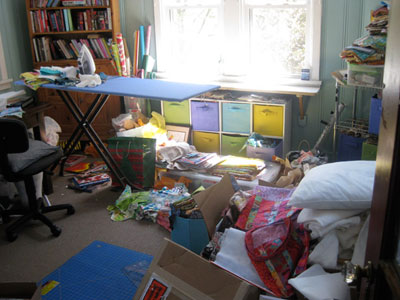
And hopefully in 2016, I will be able to re-possess my big quilt studio, as the daughter and son-in-love will be moving out on February 9.  So my tiny quilt room looks like total chaos right now.  I’ve taken this transitionary opportunity to go through my stash and sort, fold, and bolt material.

I’ve also reflected on just what kind of quilter I am…

I do like to take classes and teach classes.  I love to share with other quilters and learn from them, too.  So I am a “joiner.”  Guilds, bees, groups --  I have membership in at least eight quilting groups.  For years, by necessity, I functioned as a “lone quilter.”  When I started quilting in 1988, there were no groups that I knew of and instruction was few and far between.  Those logistics, coupled with the fact I had two small children and was working made either option almost impossible even if I could find them.  So I am  a “Social Quilter.”
 

I’m also tend to quilt some each day.  Ideally, I like to do some piecing, applique, or quilting before I go to work.  It settles and centers my mind and thoughts.  Regardless, it’s a rare day that some fabric doesn’t find its way between my fingers and my needle. 

Those are two things I don’t want to ever change about the quilting me.

However, I do hope this year to be more like this…. 
 

Organized and on point…. 

Instead of like this…
 

Which is what is seems like most of 2015 has been like.

I did finish one top and several squares over the two weeks I’ve been away and will be posting picture of them on next week’s blog. 

Until then…

Love and Stitches…


Sherri

Saturday, December 19, 2015

So On The Way Home I Bought a Lotto Ticket.....


Let me start this week’s blog off by stating two things.

First, Thursday, December 17, was my Guild’s Christmas party.

And second, I never win anything.

I don’t.  I can buy a dozen lottery scratch-off tickets and won’t win a dime.  I can buy dozens of raffle tickets and get nada in return.  This has been my life since I was old enough to play BINGO in kindergarten.

Until Thursday night at the Christmas party. Besides being just the normal Christmas-party-type-event with the food, desserts, and fun, we were drawing tickets for the guild’s 2015 raffle quilt and the 2015 charity raffle prize.

I loved the raffle quilt.  I really did.  What wasn’t to love about this?
 

I had purchased two envelopes worth of tickets and crossed my fingers and toes and bra, but my name wasn’t drawn.  I wasn’t shocked, given my history, but was placated with the thought that I did have the instructions and could make my own.  After all, I had helped construct the 2015 raffle quilt and now knew the ins and outs of the pattern and a few very strategic short cuts.

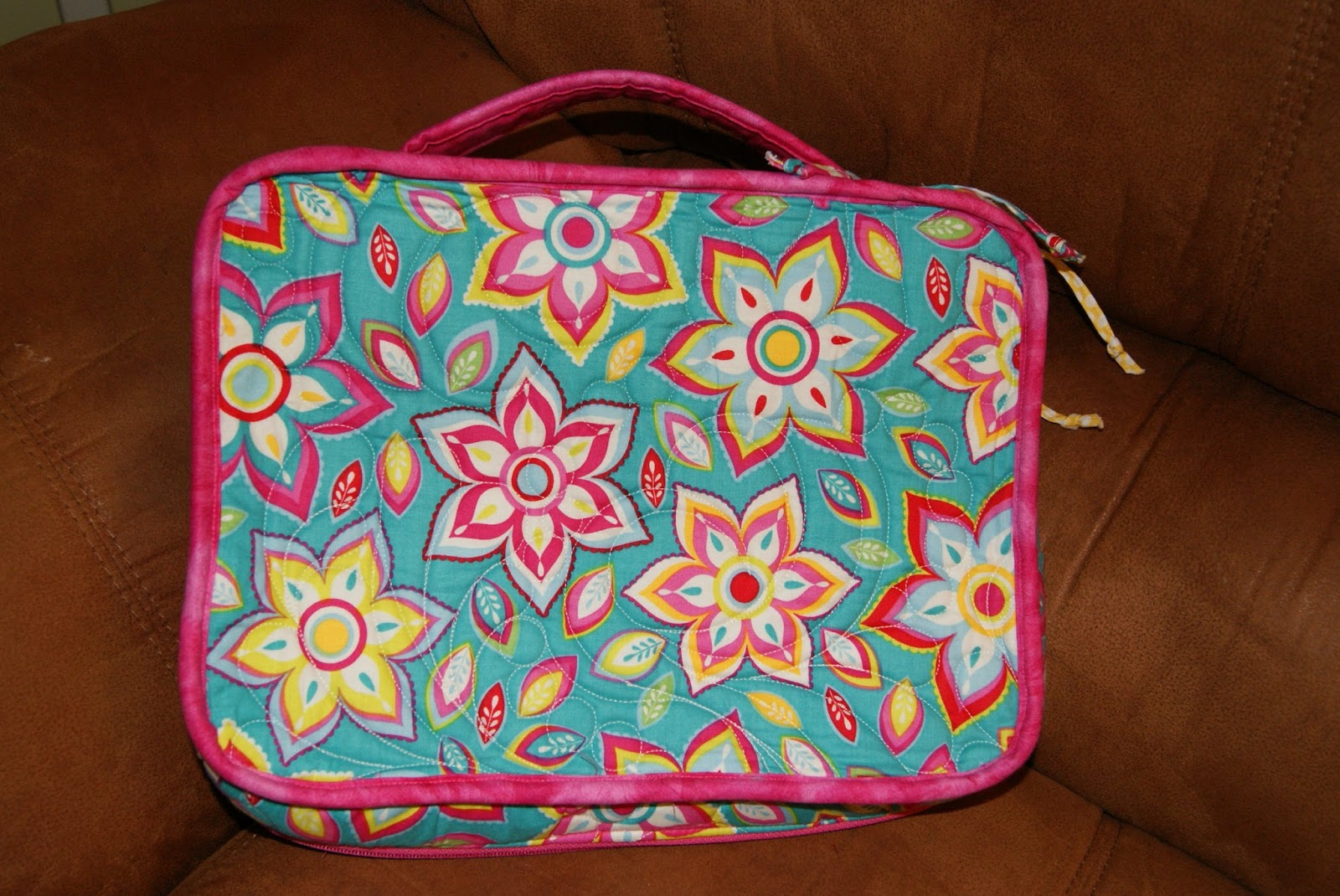
However the prize I really, really wanted to win was the crafting accessory bag that the Charity Quilt program was raffling off.
 

My good friend, Linda, had made one of these a couple of years ago and I had lusted after hers ever since.  I even strongly suggested that the guild make one for me as the outgoing gift at the end of my presidency.

Instead they gifted me with a gorgeous purple and white signature quilt that not only has every guild members’ name on it and my years as guild president, but also acknowledges that I was the founding president.  I cried when I received it and cry nearly every time I look at it.  It’s perfect. 

A few months later I purchased the Craftsy class for the bag and the zippers and vinyl to go with it.  I already had the fabric and had pretty much decided that as soon as cold weather set in so I couldn’t be beckoned outside, I would put in the hours on the bag. 

So when my name was drawn for the bag, I didn’t believe it.  They had to show me the ticket.

Hot damn!  Oh boy!

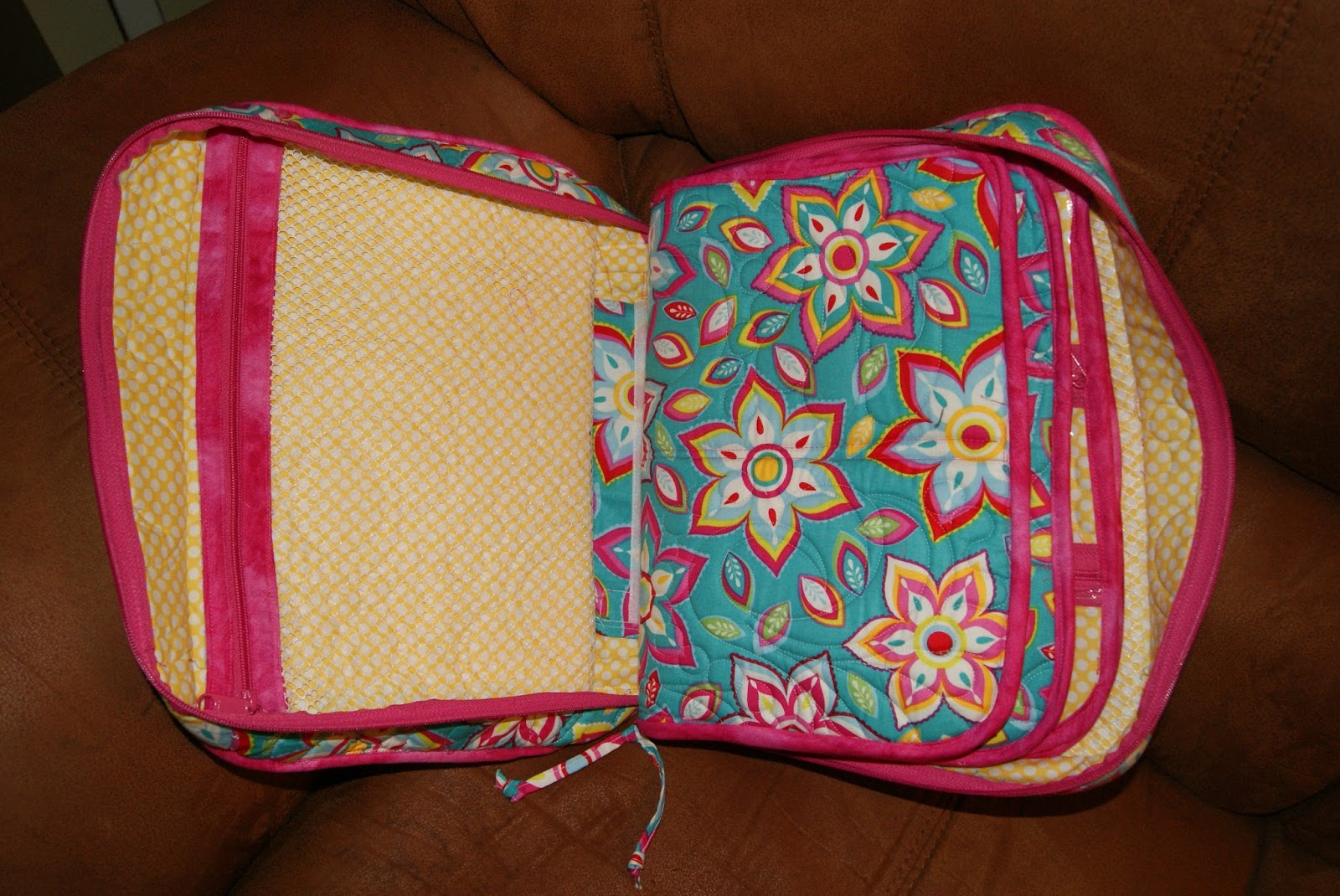
This. Is. The. Most. Wonderful. Bag. Ever.

Just look at all the compartments! 


But my good luck didn’t stop there.  We were instructed to bring four fat quarters with us to the party.  The first-vice president then led us in a great game of Dirty Santa.  If you’ve ever played this game, one of two things will happen.  Either everyone will be very nice and accept whatever is in their package without dissent; or there will be that one present everyone wants and it’s nearly a free-for-all until it’s claimed for the last time.

Take a gander at these fat quarters….
 

Nearly everyone wanted them…they were possessed by so many people I thought we were going to have to call an exorcist before someone would be able to take them home.

But guess who they ended up with at the end of the evening?

That would be me.

I had never had that much luck in one night EVER.

So when my good friend Nancy laughingly suggested that with the run of luck I was having, it may be a good idea to buy a lotto ticket on the way home, I kind of shrugged off her idea.  After all, how long of a good run of luck could I have? 

Then I began doing the math.  I’m 54 years-old.  I’ve never had this much good fortune in one sitting in…well, forever.  Mathematically the odds were in my favor.  And it would only take a few minutes.

This was my reasoning as I eased my SUV into a brightly lit convenience store that sold scratch offs.  I made my way inside and purchased a single scratch-off ticket…

And won ten bucks.

It has been a very Merry Christmas so far….

Love and Stitches…


Sherri

 PS...There will be no blog next week, as it's Christmas at my house.  I wish those who celebrate this holiday, Merry Christmas.  For those that are celebrating Hanukah, I wish you Hanukkah Sameach.  And for those celebrating Kwanzaa, Habari gani?   If you don't celebrate any of these, have a great few days off and get some rest!